Uni Game Art Project
Creating a complex asset from scratch for my university module "Project: Game Art"

05/2025 - 08/2025

Art, Programming

Blender, Unity

1

On Request
Description
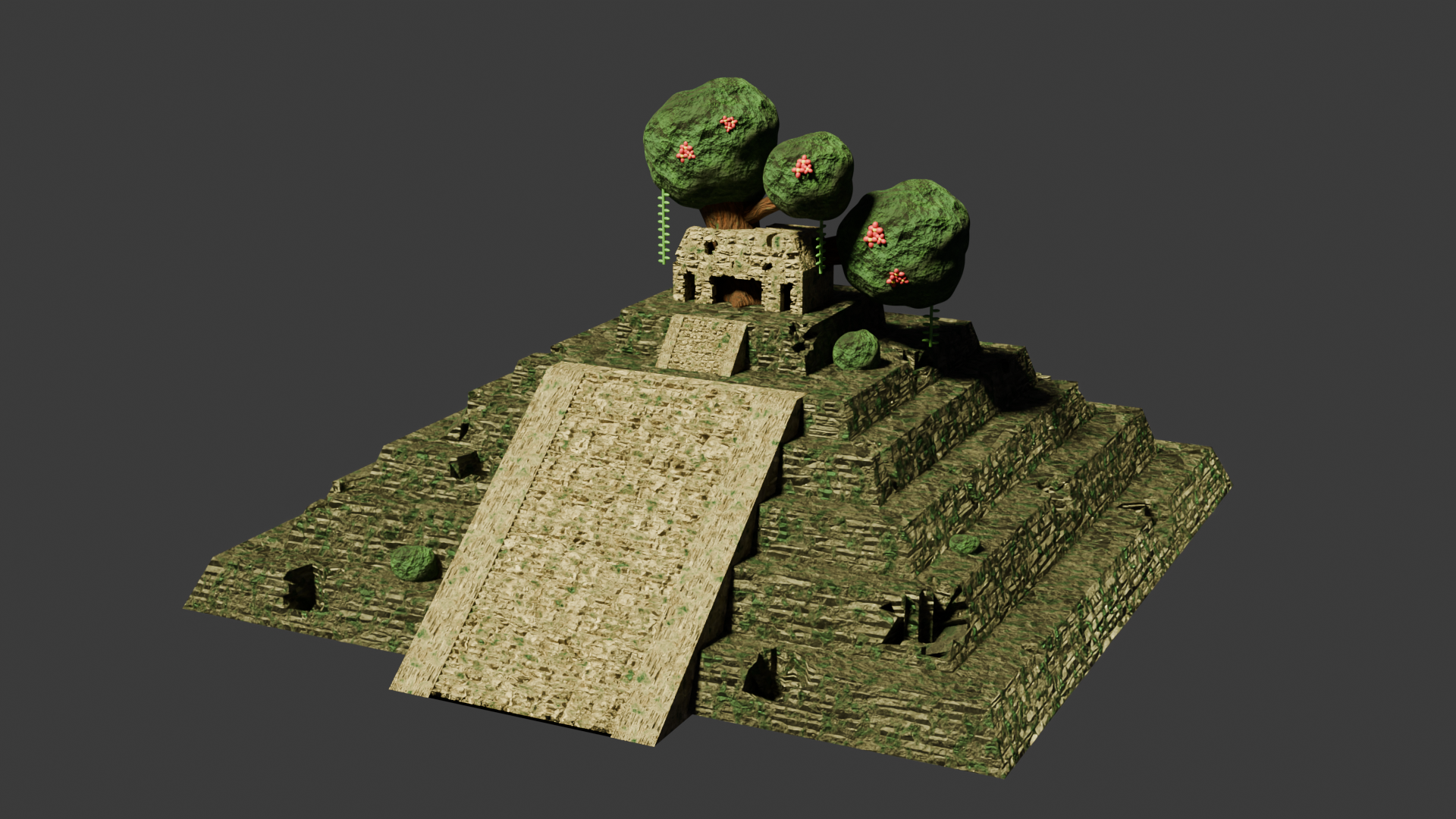
This project was created for my university course "Project: Game Art" over the course of three months. I designed a game and then created this asset completely from scratch in blender and exported and implemented it into a scene in Unity.
Story
The asset is an ancient Maya temple, that has been lost in the rainforest. You and your group of archaeologist friend are searching for the lost village in which the temple once stood and try to find out what happened to the village and restore it for the world to see.
Features
For this project I used Blender to create to model and Blenders shader nodes to create procedural textures. I also exported the model and baked diffuse, normal and roughness maps so it could be implemented into Unity. The result is a game ready asset.
Workflow
My project workflow was structured into three phases: Concept Development, Design & Exploration, and Final Production & Reflection. In Concept Development, I brainstormed the given theme and setting into a rough game idea. Then I did research and analysis of comparable games on the market, focusing on target audience, gameplay appeal, visual aesthetics, perspective, and genre. Based on this research, I defined the intended player group and created a detailed player persona to better understand their needs, preferences, and gaming habits. I then developed the foundation of my game world through mind maps and a mood board, where I explored themes, locations, characters, moods, color palettes, and visual references. From this, I defined a coherent visual style and technical approach. All findings, sketches, design ideas, and decisions were synthesized into a Visual Concept, accompanied by a written reflection documenting my design process and regular screenshots for a “Making Of” documentation.
In Design & Exploration, I selected one prop to implement and explored its form through multiple thumbnails and silhouette studies. After evaluating these variations, I chose a final concept and developed it further into a detailed, colored design or model sheet. This phase emphasized consistency with the visual concept, player preferences, materials, textures, and narrative context. All steps, iterations, and decisions were documented, including unsuccessful approaches, to ensure transparency and reflect on design choices.
In the Final Production & Reflection, I finalized the selected asset in 3D using Blender. The asset was prepared and exported for implementation in the game engine Unity, where I set up a lit presentation scene and tested all materials, textures, and data via re-import. The final results were presented through rendered images, a Unity package, and a comprehensive PDF documenting all three phases. Additionally, I created a recorded video presentation explaining the project, the workflow, and the final asset within Unity.
Key takeaways
Creating the game and then working on one asset of it was a very rewarding task, since I was not that experienced in game art and was able to learn a lot. I really liked working in Blender and learning more about it. Especially the shader nodes system was very interesting as it was similar to Unreal Engine blueprints. The model and textures in Blender turned out very well and the implementation of the model itself in Unity was very easy.
Improvements
Creating the textures in Blenders shader nodes was a very new task for me, which is why it ended up very unoptimized. Because of this, baking the textures, which I had to do because Unity does not support Blender shading nodes, took a long time and created huge files with suboptimal resolution. I did not know that it would be that troublesome before so I had to rush it at the end for the Unity implementation. Next time I would optimize the texture nodes better or use a different way of creating textures, so it is easier and less resource intense to implement into Unity.
Info on documentation
The full course documentation for the game can be requested. However, it is only available in German.